Sunday, 25 October 2009

the facilities that the local community provides....

This blog posting is about the facilities in our area for the local community. But these facilities are not just in the area of Bukit Batok where we live, we see this all over the island.

The local community is very well provided with many walking paths, coffee shops, hawker stalls for food, large BBQ area's, special area's set aside for Tai Chi or personal exercise, multi generational exercise area's, childrens playgrounds, plenty of seating to sit and chat.

All these are set around the HDB (Housing Development Board) flats. This is the Singapore version of public housing that is totally different from the usual public housing that you hear of or see in Hong Kong, USA, Europe or China.

These HDB flats are good quality well built and immaculately maintained government subsidised housing. Very close to the specifications of a condominium but without perimeter fencing and private facilities like swimming pool, club house, tennis courts or a gym. These HDB flats are usually purchased and owned.

You can read a little more about living in a HDB flat in one of my blog posts by clicking HERE.

This first image is of the area across the road from our condo..... about 40 or more people meet each morning for Tai Chi at about 7.00am. It is especially nice to stop to watch them, but also to listen to the soothing and relaxing music.

After school and at weekends this area usually has people playing basketball and other games.

In between all these HDB buildings you see many walkways, most are covered to keep the sun and rain off the people. Some have a few steps, but most have these very easy ramps for the disabled and the older generation. See image below....

The next three images are of the BBQ areas set aside for the residents of the HDB's. A lot of thought and planning has gone into making the local area's very livable for everyone.


..... and a new multi generational exercise area has just been completed close by,


the first few images are of the older exercise area across from us, as seen here.....


and here is John trying out the new exercise area just completed and is past the train station, but only 5 minutes walk from us here at The Jade...


Singapore is to be congratulated on providing all these community activities for the local residents ....... we are impressed with the equipment, the upkeep of them and the cleanliness surrounding these area's.

Kudos to the Singapore authorities and the local residents !!!

Saturday, 24 October 2009

a little about The Nine Emperor Gods Festival ....

today on the way home in the cab, we were discussing with the driver about the Festivals on in Singapore and in particular one that was on this weekend..... he proceeded to tell us all about the Nine Emperor Gods Festival and which explained why all the flags are flying around our area this past week or so...

.....on arriving home I proceeded to hit the 'google' button and learn a little more about this nine day celebration. The following is what I have come up with.... hope that you find it interesting and you now know a little more about the culture of this wonderful country.


above image taken by sampura in Nov 2006
released from copywrite:
 
Photo is of Temple volunteers in white attending to the sedan chair, in which the unseen Nine Emperor Gods are believed to be seated in...

The Nine Emperor Gods Festival is a nine-day celebration observed primarily in Southeast Asian countries like Singapore, Malaysia, and Thailand.

The Gods Festival popularly called the Nine Emperor Gods Festival takes place during the month of October every year in the premises of the Kiu Ong Yiah Temple in Singapore. The Gods Festival (Nine Emperor Gods Festival) is celebrated to seek blessings from the Nine Emperor Gods and pray for their own prosperity, longevity and health.

The Festival in Singapore is celebrated through nine days of colorful street parades, wayangs (Chinese operas) and prayers. The Gods are paraded from the temple on to the busy streets on decorated sedan, which is drawn by eight bearers carrying incense, on the ninth day of the Gods Festival. The smoke of the incense is considered auspicious and people try to capture some for financial success in the future. The priests use their own blood to write charms during the climax of the Nine Emperor Gods Festival in Singapore.

The Gods festival is one of the loudest as well as the most sacred festivals in Singapore. One of the main attractions of the festival are the flag bearers who dance to the sounds of drums and cymbals and take part in the street parades when the nine gods are again brought back to their abode at the temple after a brief sojourn.

The Festival is one of the most exotic folk festivals in Singapore, and yet one that is hardly publicised and known even to most of the Singaporeans. Although 50% of Singaporeans are followers of Taoism and Buddhism, this festival is mostly celebrated by devotees of the Jiu Wang Yeh Sect at a few suburban temples, the more popular of which is the Kiu Ong Yiah Temple (“Nine Emperor Gods Temple”; also known as "Dou Mu Gong" in pinyin Chinese) on Upper Serangoon Road.

you can read more about this festival on the WeeCheng Website.

Here in modern Singapore where 80% of the ethnic Chinese population is of Fujian and Guangdong descent, these ancient traditions lurk behind the jungle of skyscrapers and state-of-the-art automated subway systems. Away from the glass towers of investment banks and endless miles of shopping malls, in the relaxed suburb of Upper Serangoon - and elsewhere in the Heartlands - where locals still drink traditional Singapore style coffee on marble tables under old turning fans, a small crumbling temple built over a century ago is the Mecca of the Jiu Huang Ye Sect in Singapore. Brightly embroidered banners proclaimed the miraculous powers of the Nine Emperor Gods and their Mother, Dou Mu, amongst scared icons of these Taoist saints. On an average day, however, the temple is quiet, with an occasional worshipper or two, praying for a better fortune in the next lottery bet, or swift recovery from illness.

On the eve of the ninth moon, temples of the deities hold a ceremony to invoke and welcome the nine emperors. Since the arrival of the gods are believed to be through the waterways, processions are held from temples to the sea-shore or river to symbolize this belief. Devotees dressed in traditional white, carrying incense and candles, await the arrival of their excellencies.
A carnival-like atmosphere pervades the temple throughout the nine-day festival. During this period of time, the constant tinkling of a prayer bell and chants from the temple priests are heard. Most devotees stay at the temple, eat vegetarian meals and recite continuous chanting of prayer. It is believed that there will be rain throughout the nine days of celebration.

The ninth day of the festival is its climax. A procession which draws scores of devotees send the deities back home (a waterway such as river or sea).

During a period of nine days, those who are participating in the festival dress all in white, which has come to be translated as abstinence from eating meat, poultry, seafood, and dairy products. Vendors and proprietors of restaurants indicate that je food is for sale at their establishments by putting a yellow flag out with the word เจ (je) written on it in red. However, technically, only food prepared in the sacred kitchen of the Chinese temple (in Thailand, called san jao ศาลเจ้า or ahm อ๊ำ) is je, as it must undergo a series of rituals before it can be given that name.

So look out tomorrow night (Sunday October 25) for the Gods and their magical wild rocking chairs!


Monday, 19 October 2009

in front of the Main Temple


in front of the Main Temple
Originally uploaded by Leone Fabre.

just heard that British Airways want to use this image in their advertizing campaign for Mauritius.

Have had other images used in the InFlight magazines for Malaysian Airlines and Qantas, this is a first with BA.

am HAPPPPPPPY :-)

washing day in Singapore!!!

Singapore has a tropical climate. That basically means it's summer all year round. With such heat, few families see the need to purchase dryers. The norm is to simply stick your clothes out to dry on bamboo poles. I do not have a dryer and nor do I need one, but I do use poles on a stand that sits on the balcony ...... I do not have the courage to hang the poles out like those seen here, but also in apartments and condominiums, bamboo poles are used but are hung up in the yard or washing area within the unit, usually just outside the laundry area .... and one must remember that courtesy dictates that you wring your laundry before hanging them out or you'll receive a generous dose of scolding from the lower floors.

Dripping wet mops are also an invitation to angry neighbours from the lower floors!!


More than 80% of Singaporeans stay in HDB flats, Housing Development Board (HDB) Flats.

This is the Singapore version of public housing that is totally different from the usual public housing that you hear of or see in Hong Kong, USA, Europe or China. The above images are of HDB units.

These HDB flats are good quality well built and immaculately maintained government subsidised housing. Very close to the specifications of a condominium but without perimeter fencing and private facilities like swimming pool, club house, tennis courts or a gym. These HDB flats are purchased and owned.

In the early days, pigeon holes were used to describe HDB flats by visitors to Singapore. From afar, HDB flats do resemble pigeon holes. Back in the 70s, the main driving force behind HDB flats was to provide Singaporeans with basic housing and nice design was not a priority.

Affluent Singapore today has seen substantial changes in HDB flats design matching those of private condominiums and the introduction of Executive Condominiums (EC), hybrid housing between HDB flats and condominiums.

The sight of clothes hanging on bamboo poles sticking outside the kitchen windows of HDB flats will surprise many. This is the signature of HDB living and is a sight to behold. Imagine an entire HDB flat on a sunny day with bamboo poles full of clothes sticking out of every unit. And yes, you guessed it, undergarments included. What a sight!

in the next blog post I will explain a little more about these HDB flats / apartments / units and the facilities surrounding them.

Sunday, 18 October 2009

our lunch today at the local hawker centre


Today (Sunday October 18) we went to one of the Hawker Markets for lunch with friends .... It's something that Singaporeans take for granted: cheap and delicious hawker food at the food centres. They just assume that every other city has similar offerings. Hopefully they will soon realise that cheap local food in Singapore is really something quite special.

My meal today - Char Siew Wanton noodles - that is Roasted Duck with greens and noodles and a bowl of soup with wan tons in (see above) cost only $2.80. That is Singapore dollars!

I also had fresh lime juice with that and the sum total came to $4.30 SGD. Now to change that into currencies my readers may understand - the $4.30 equals:

USD $3.08
CAD $3.20
AUD $3.34
and in EUR 2.07

Great prices for a nice tasty and quick meal ...... now a Hawker Market is where you mostly see locals (Singaporeans) eating local food, but we also noticed a store that sells WESTERN FOOD!!!

Singapore Hawker Centres (or "Food Centres") is the name given to open-air complexes in Singapore housing many stalls that sell a variety of inexpensive Food. They are typically found near public housing estates or transport hubs (such as Bus Interchanges and Mass Rapid Transit (MRT) stations).

The hawker centres offer multi-ethnic Singapore Cooking at its best. Whether it's a simple dish or noodles for S$3 or a S$20 three-course meal of barbecued fish, chilli prawns and fried vegetables served with rice, the cost is a fraction of what you would pay for the same meal in a restaurant. No wonder that eating at or buying food home from hawker centres is a common part of the Singapore lifestyle. Prices apart, the experience is unique. A visit to food-crazy Singapore isn't complete without taking a meal at one of these vibrant, colourful places.


For the uninitiated, here's how you order a meal at a Hawker Centre. If there's a group of you, have one person sit at a table to "chope" (ie. reserve in local parlance) seats for the rest of the party. Don't be surprised if you see seats with bags or packets of tissue paper on them; it's a sign that they have been taken.

The others, having taken note of the table number, should then proceed to survey the various options. When ordering food, tell the stall owner the table number, unless of course it's a self-service operation. If you're on your own, you can share a table with strangers. As you savour your meal, you will realise why true-blue local gourmets will head for their favourite Food Stall at every opportunity.

In the past, there was no such thing as a Hawker Centre. Instead, the term "hawker" was once used to describe food vendors who moved their wares around in mobile carts. The sound of an ice-cream bell, or the clacking of a wooden block, or the chant of the Mua Chee man selling sticky nougat-like candy, would send children - and their parents - scrambling from their homes into the streets to buy their favourite snack. The fare on offer was amazing. From bread and bowls of steaming noodle soups to peanuts and Poh Piah (spring rolls), the roving hawker was a familiar fixture in the neighbourhood. Then came the roadside hawker, setting up shop on the streets after dark, when parking lots were emptied by cars and replaced by wooden tables and stools, and a pushcart which doubled as the kitchen. Such hawkers have pretty much disappeared from modern Singapore, but hawker-style food remains hugely popular in the Singapore lifestyle.

In 1987, the last of the roadside hawkers were cleared, but Chinatown's Smith Street has revived the carnival-like atmosphere of street-side dining with the recent launch of its bustling food street.

Most of the above from this website.

Saturday, 17 October 2009

going fishing ..... at The Tekka Market in Singapore


Tekka market was originally known as Tek Kia Kha, meaning "foot of the small bamboos" in Hokkien. This was in reference to the numerous bamboo plants that once grew along the banks of the Rochor Canal. The original Tekka market was built back in the early 20th century, before it was relocated in the early 1980s to its present site across Buffalo Road.

Today, Tekka market is arguably Singapore's largest indoor wet market and boasts an incredible array of seafood, meat and fresh produce including herbs such as fresh dill, lush roma tomatoes and char grilled artichokes, seldom found elsewhere......

we spent most of the morning wandering around the fish stalls of which there were many!


I love wandering around markets, food markets in particular and some of my regular blog readers will remember my other blog posts on markets:

Port Louis Market in Mauritius.

Market in Siem Reap (Cambodia)

Indonesian Fruit Market

Ice Delivery at the Tekka Market


.... other food photos of the Tekka Centre will be in the next blog post.

Friday, 16 October 2009

a wander around Little India


When living in or even visiting Singapore, one must visit "LITTLE INDIA" at some point..... there is so much to see, smell, hear, witness, experience and enjoy!

As you step into Little India, be prepared for an assault on the senses! You will be greeted by the strong, heady scent of spices and jasmine garlands, followed by the treasure trove of silverware, brassware, wood carvings and colourful silk saris, dazzling to behold. Pick up a walking guide and start your exploration of this colourful ethnic quarter.

You can purchase just about anything from flower garlands to bracelets, from vegetables to Sari's, from fruit to perfume ..... it is all here.

The first Indian settlers in Singapore arrived with Sir Stamford Raffles as assistants and soldiers back in 1819. In the late 19th century, many more Indian immigrants arrived to find work, be it as labourers to build roads or to take up key positions in the civil service.

Today, Little India is the focal point of Singapore's Indian community. Its spice-scented streets beckon you to a cornucopia of ethnic jewelery, jasmine garlands and silk saris. From the large Tekka Centre and Little India Arcade to the small provision shops, Little India is packed with interesting things to discover. During Deepavali (usually between Oct/Nov), the Indian Festival of Lights, Little India is transformed into a fairyland of gaily decorated, brightly lit streets bustling with shoppers.

Colourful temples co-exist side by side with churches and mosques, parrot fortune tellers stationed by the five-foot way and tantalizing scents of spices drifting out from restaurants. Don’t leave Little India without a temporary Henna tattoo or try “Teh Tarik”, a hand pulled cup of tea.

You can't miss the garlands along Little India's "5-foot-ways", they are an enduring sight on Buffalo Road. The walkways outside most colonial shophouses in Singapore are 5 feet wide. A legacy from the colonial town planners. Hence, the name 5-foot-way.

The air is an indescribable mixture of smells - the scents of flowers, incense and spice. Your nostrils must get ready for this unusual mix.


more about Little India click HERE.

or for more of my blog posts on Little India click on the following:

Ice Delivery in the Tekka Centre

Watching the Henna Artist at work


I have my eye on you

Deepavali 2009

Deepavali 2007

Janine's visit - April 2007

more about the Tekka Centre and Little India on my next blog post !
.

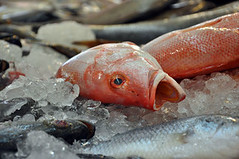
I have my eye on you....


I have my eye on you....
Originally uploaded by Leone Fabre.

Singapore is known for its morning markets selling fresh fruits, vegetables, meats and of course, fish. Known as "wet markets".

Wet markets are a great place to shop for fresh food at excellent prices, although the smells and the melting ice water on the floor can be disconcerting. A wide range of fresh vegetables, fruit, meats, fish, spices or flowers can be bought.

Generally prices are much lower than they are in the supermarkets. While a shopper can barter, it may not be well received by some stallholders as goods are already priced very low.

All wet markets open early to the public; the Senoko Fishing Port Market at Woodlands Avenue opens at 01:00 when the bulk of the customers are stallholders in other wet markets across the island.

Generally there will be less fresh fish and very little pork (all "local" pork comes from Malaysian farms and must be ferried in) on Mondays.

Note: Supermarkets will always have stock of fresh meats and fish as they import from all over the world. Many of the products in supermarkets are imported from Australia and New Zealand.

Most of the fresh food stalls and markets close around midday; none stay open all day.

The above photo was taken at the Tekka Centre in Little India.

More blog postings on Little India to follow!