Monday, 19 December 2011

the terraced rice fields of Vietnam ....


One of the main characteristics about the landscape in Northern Vietnam are the terraced rice fields. The irrigation works around Sapa (North Vietnam) extend like huge flights of steps far up along mountainsides. These terraced fields have been built since antiquity and maintained at a extraordinary cost in human labor and toil.

As we trekked around the mountains and down in the valleys, we could see these terraced fields for as far as we could see. The hill tribes around Sapa are subsistence farmers who live off their land and the livestock they own. They do not pay taxes, but they also do not receive any government pensions or other social services. They grow rice for their families, which is backbreaking labor and in a bad season the land does not provide enough rice to feed them. In that case the Vietnamese government helps by distributing 300kgs of rice per family to the villages.


Terrace building and water control, reputedly the "eighth wonder of the world," is a distinctive cultural phenomenon of Asia. Terracing, as done in many parts of Asia, consists of building stone walls, often without mortar, along the slope and contours of uplands being converted into cultivated land. The walls might be given a slight batter (receding upward slope) or inward lean at the top. These walls often exceeded six meters in height and were topped with sluices for water drainage.

Earth materials would then be used to fill each unit to a level just below the top of the wall. By then staggering the field units in overlapping manner at different levels, a whole mountain slope might be terraced toward the top such that it resembled a sculptured system of fields covered with rice and other types of crops. The field units may be as narrow as 2.5 meters but as long as 90 meters on steep slopes. They are, however, commonly much wider and not so long.

For irrigation, water is usually introduced at the top of a terrace series or sometimes as a complementary supply at an intermediate point. The water that is supplied then moves through sluices in each field by gravity downward across each level of the terrace. Finally, the water empties into a stream channel at the bottom of the valley.


The terraced rice fields of Vietnam are an amazing sight. This is not a place to rush any journey, you do need the time to stop and absorb what is around you!

all of the above images of the terraced rice fields were taken by 
JOHN FABRE with the Sony Cybershot.
PREVIOUS BLOG POSTS - on our visit to Hanoi, Halong Bay and Sapa
Blog posting on the first part of our trekking experience


HELPFUL WEBSITES FOR HANOI and SAPA AREA's:

The Man in SEAT 61 (website on train travel)
HANOI KIDS- volunteer tour guides - hotel can organise if you book well ahead.
KOTO Restaurant  - hotel can book a table for you.


This is just one of the many blog posts of our visit to Hanoi and beyond. 

So stay tuned for more updates!!


Saturday, 17 December 2011

the Market in Sapa


Soon after we arrived in Sapa, our guide offered to show us around the local market. I always enjoy visiting any market in any country of the world and this one was no exception.  Though to be honest there were a few 'sights' that did my head in ... and I thought at one point John might head back to Hanoi, but we survived and I actually did enjoy most aspects of visiting the local market as you will see by some of the images below.

The market in Sapa is located at the center of the town and and is open every day. But quite crowded on Saturday late afternoon and evening.
 
John with the two ladies (Mei and Cor) from the H'mong Minority Tribe 
and Huang, our guide for the Sapa Tour.

Until the late 1980s, when the population of the region was small and transportation was very poor, It was difficult to communicate among the outlying villages, the market offered probably the only chances once a week for H’mong and Red Zao peoples to meet others. 

The main market took place on Sunday but many went to the market on the Saturday  afternoon, mainly because the villages were quite some distance. Of course there were no accommodation, so to pass the night they gathered around the fire's talking, playing their traditional music, dancing…

Gradually these activities attracted the youngsters from villages near by to come and turned the market into a dating place for lovers. These days due to the development in the region and making it easier for locals to communicate among villages, as a result, the market in Sapa has been becoming less important spiritually. However, it is still crowded every weekend and worthwhile to spend few hours wandering around - just for the experience.


 each time I see the above image, I think of the "Chicken Dance"!


 there were plenty of stalls selling fresh vegetables and fruit ...


*note*
If you are intending to go trekking around Sapa, the ladies from the minority groups will surely follow you. Most are hoping that you will buy some small trinket or souvenir. You might find about 5 or 6 following you around the town. They do understand the word NO if said politely. Do not say 'later' as they will take that literally.
These people are delightful and you can learn much from them as you are trekking.

You might find that only one or two will stay with you past the edge of town, knowing the guide that is with you, they will know that you are trekking for the next few hours too ... do not disregard them... treat them with the respect they deserve.

These ladies will be of enormous help over the next few hours.

The two ladies that came with us were from the H'mong Minority Group, their names were MEI (May) and COR (Kerr) .... these two ladies were amazing, they were always there to hold our hand, guide us over a muddy patch, show us different things along the way etc and we even managed to visit the family home...

They had asked if we would buy something from them and we had said no. 

Prior to our trip, we heard that people buy things to take to the villages or families, things like pencils or candy bars etc. Some people just give money.

We felt we would rather give something else, so while at the market we filled our day pack with bananas, mandarins and apples .... we shared these with both ladies at the end of the day saying that the fruit was for the children. They certainly appreciated the fruit and thanked us profusely.

The guide later told us, that in all the years he has been taking people trekking into the mountains, no one has ever bought fruit for the families ..... you may like to also consider doing this if you intend to be doing any trekking out of Sapa.

We did buy a few things off them at the end of the day as well. But more about that later.
 If your guide offers to take you to the market, do so .... it is really a 'local shopping experience' that you won't get back in your home town!

Interesting to note that before the French built Sapa town into a town, the market place was on the sandy ground about 7 km east of the town, at the junction of the main road to Lao Cai and the trail to Ta Phin Village. 
* * * * * * * * *
PREVIOUS BLOG POSTS - on our visit to Hanoi, Halong Bay and Sapa
The Man in SEAT 61 (website on train travel)
HANOI KIDS- volunteer tour guides - hotel can organise if you book well ahead.
KOTO Restaurant  - hotel can book a table for you.


This is just one of the many blog posts of our visit to Hanoi and beyond. 

So stay tuned for more updates!!
(especially our trekking outside of Sapa)


Friday, 16 December 2011

arriving in Sapa ......

........ as mentioned in the previous post, we took the overnight train from Hanoi to Lao Cai, then the shuttle bus to Sapa. We had booked our trip to Sapa, including the train journey, the trek and the overnight stay through the hotel we were staying at in Hanoi, The Royal Palace Hotel.

Everything was organised through them via emails with ourselves and it all went very smoothly despite some of my initial fears. The hotel staff took us direct to the train and even to our carriage to make sure we were in the correct cabin and off we went .... at 5.00am the following morning we arrived at Lao Cai Rail Station and were met by the driver of the shuttle bus that was taking us to Sapa.
  
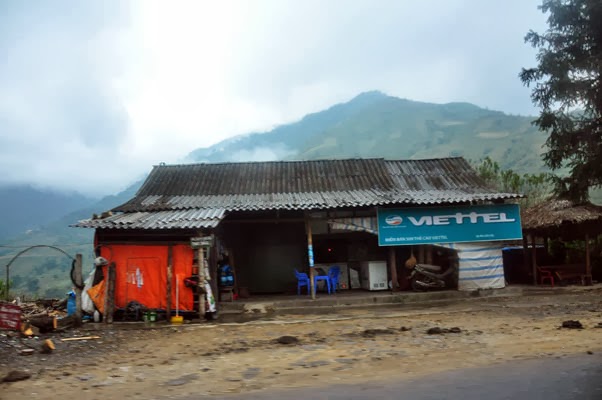
above: some of the buildings seen on our way to Sapa.

It was quite cool and misty on the drive up the mountains and we could see very little scenery due to the pre dawn darkness early in the drive and then the mist over the mountains. By just after 7.00am we arrived in Sapa and we were met by our guide who then took us to the hotel - Royal Sapa Hotel - for breakfast and a shower.

 view from the back decking of the hotel.

The hotel was nothing outstanding and certainly not 5 star, but our breakfast was adequate and the room allocated to us for a shower was just OK.  We were supplied towels, supposedly white towels but with a distinct grey tinge to them!!

You do need to take your own toothbrush / toothpaste / hand towel / small container of shampoo and soap. But it is a shower and was very welcome after the overnight train journey and sleeping in our clothes!

By 9.30 the guide came and went through our itinerary with us, where we were trekking, the weather, the home stay, the food and anything else we needed to be aware of...... soon after we left the hotel with one day pack and the camera bag between us. We had left the other day pack with the hotel reception.

the following are some of the 'usual' scenes around Sapa ..


 above: the ladies from the Minority Groups wait outside all the hotels for your custom.

Our guide first took us through the market area where most of the local people in Sapa do their shopping and where we saw many sights best left unsaid!

But a visit to any market anywhere in the world is an experience not to be missed ..... as seen in the next blog posting. A Visit to Sapa Market!


PREVIOUS BLOG POSTS - on our visit to Hanoi, Halong Bay and Sapa
Blog posting on the overnight train journey 


HELPFUL WEBSITES FOR HANOI and SAPA AREA's:
The Man in SEAT 61 (website on train travel)
HANOI KIDS- volunteer tour guides - hotel can organise if you book well ahead.
KOTO Restaurant  - hotel can book a table for you.


This is the 16th blog posting of our visit to Hanoi and beyond. 

So stay tuned for more updates!!
(especially our trekking outside of Sapa)


Wednesday, 14 December 2011

KOTO - know one, teach one


We were in Hanoi for only 5 days, but out of those 5 days we ate at KOTO three times and we highly recommend it .... not just for its 'idea', but for the friendly staff, the service and the food ...

KOTO is a not-for-profit restaurant and vocational training program that is changing the lives of street and disadvantaged youth in Vietnam. KOTO - training Hanoi street kids in restaurant skills
The concept of KOTO began on the streets of Hanoi in 1996 when an Australian Vietnamese man, Mr Jimmy Pham, asked a group of street kids what they wanted out of life. They simply replied, "we need skills so we can find stable jobs" and so the concept of KOTO was born.


 In just five years, KOTO has grew from a small sandwich shop in Hanoi to a 120-seat restaurant and an internationally accredited hospitality program that gives some very special young people the start in life that everyone deserves.
 
and now Saigon......

All donations over $2.00 to KOTO are tax deductible for Australian taxpayers against their tax commitments in Australia. Please advise KOTO staff if you require an Australian Tax Deductible receipt as the payment will need to be made via KOTO International in Australia.

Become part of the KOTO Saigon foundations by buying a brick now and having your name featured at the restaurant, forever.

For $100, your brick, inscribed with your name, will be part of the KOTO Saigon restaurant’s “Brick Wall”, and be regarded as an acknowledgement of those who supported KOTO Saigon restaurant in its founding days.

The success of the restaurant is vital to KOTO Saigon as, being a social enterprise, it’s not only a major revenue source, but also a means by which trainees can gain practical experience and become more employable upon graduating. It has long been a dream of KOTO’s to bring its successful Hanoi program to the street and disadvantaged youth in the South of Vietnam, and the establishment of the restaurant is an integral part of this.

Sign-up now and be part of KOTO Saigon, forever

 ...... an Australian Vietnamese man, Mr Jimmy Pham, asked a group of street kids what they wanted out of life. They simply replied, "we need skills so we can find stable jobs" and so the concept of KOTO was born......


HELPFUL BLOG POSTS & WEBSITES FOR HANOI AREA:
HANOI KIDS- volunteer tour guides - hotel can organise if you book well ahead.
KOTO Restaurant  - hotel can book a table for you.


This is the 14th blog posting of our visit to Hanoi and beyond. 

So stay tuned for more updates!!
(especially our visit to Sapa)


Monday, 12 December 2011

St Joseph’s Cathedral in Hanoi


We recently visited St Joseph’s Cathedral in Hanoi which was opened in 1886, a year after the French colonial officially occupied the country of Vietnam. The cathedral still holds mass twice daily and is probably the most famous church in Hanoi.
 
 
Archdiocese (Metropolitan) of Hanoi (Latin: Archidioecesis Hanoiensis) is a Roman Catholic Archdiocese of Vietnam. It is one of the earliest in the history of Roman Catholicism in Vietnam.

The creation of the diocese in present form was declared November 24, 1960. It covers an area of 7,000 km² and headed by Archbishop Peter Nguyễn Văn Nhơn (from 2010).

The above images are of the garden walls within the Church grounds ...

The church was built in 1886 in the neo-gothic style. It holds several masses throughout the day and is usually crowded on weekends and religious holidays. On Christmas, 2004 the cathedral hosted more than 4,000 visitors.

By 2004, Archdiocese of Hanoi had about 282,886 believers (5.3% of the population), 59 priests and 132 parishes. The Archdiocese of Hanoi is a "sister" diocese of Roman Catholic Diocese of Orange County (USA) since 2008.


The young Catholics from the Archdiocese of Hanoi and Archdiocese of Ho Chi Minh city formed in 2006 an organization for helping children in rural and underdeveloped areas of Vietnam.


if you are spending a few days in Hanoi, do visit the Church ... even if it is to wander around the garden area ..... it is truly a restful haven away from the noisy Hanoi streets!


HELPFUL BLOG POSTS & WEBSITES FOR HANOI AREA:
HANOI KIDS- volunteer tour guides - hotel can organise if you book well ahead.
KOTO Restaurant  - hotel can book a table for you.


This is the 13th blog posting of our visit to Hanoi and beyond. 

So stay tuned for more updates!!
(especially our visit to Sapa)